Field-level tokenization & AES-256-GCM custody
Replace sensitive columns (email, phone, PAN, Aadhaar, account numbers) with opaque tokens while sealing each field with its own per-value data key.
Replace sensitive personal data with opaque application tokens while sealing original values in field-level AES-256-GCM envelopes. Enforce role, purpose and consent policies on every reveal.
Start with one workflow, connect the systems in scope, and expand only after the control has been tested.
Replace sensitive columns (email, phone, PAN, Aadhaar, account numbers) with opaque tokens while sealing each field with its own per-value data key.
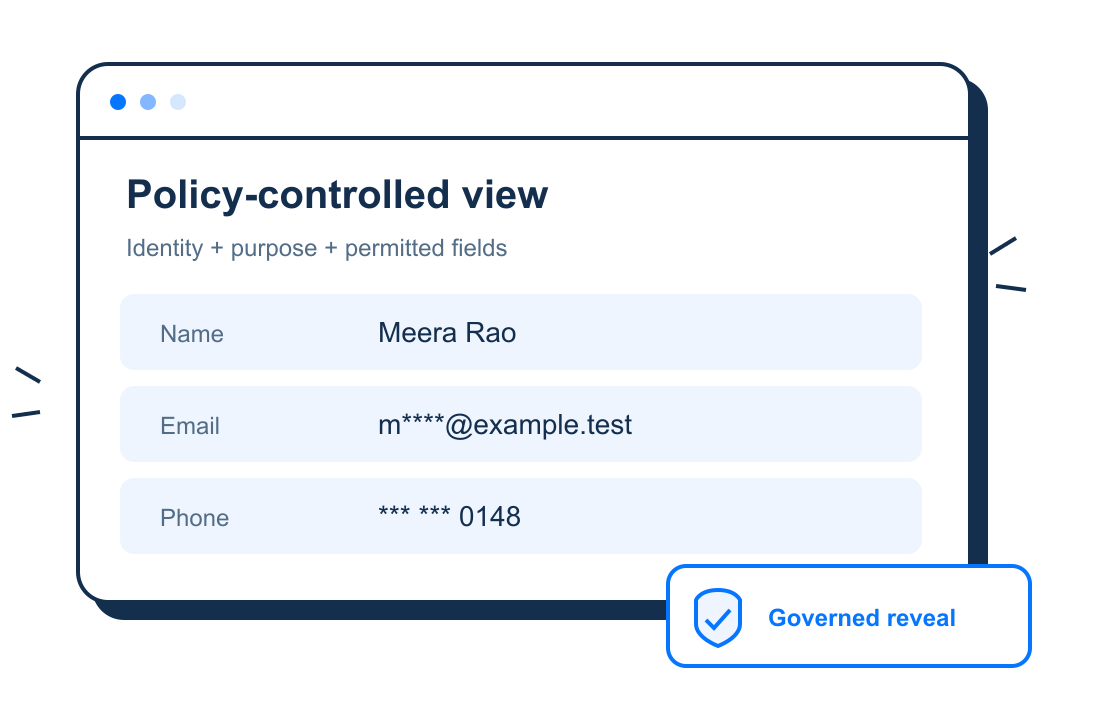
Evaluate RBAC, PBAC and ABAC policies plus live consent state before returning full values or masked views (such as m****@example.test or *** *** 0148).
Protect each tenant’s key hierarchy under your KMS boundary, supporting key rotation, instant revocation and cryptographic erasure.
Record every seal, reveal, refusal and erasure in a chained, signed audit trail that can be verified offline without exposing plaintext.
Seal once. Use safe references across applications. Reveal only at the governed edge.
 Privacy vaultDetect · tokenize · encrypt
Three real views from one synthetic customer path: source plaintext, application tokens, and sealed Securelay custody.
Personal details appear in the original record.
Selected fields become tokens. The application keeps its customer record.
The protected values are held separately, encrypted by field.
What these screenshots prove. Protection applies to the fields and routes you connect. Tokenization reduces exposure; it does not make every copy or remaining field anonymous.
Send selected sensitive fields to the Securelay Data Vault and store the returned opaque tokens in your application database.
When a workflow or AI route needs a protected field, Securelay checks caller identity, purpose, consent and field masking rules.
Export signed audit receipts for compliance reviews, or crypto-shred a subject’s vault cells when erasure is required.
Protection applies to the fields and routes you integrate with the Data Vault. Unintegrated databases, client-side logs or external copies must be brought into scope or erased through their own workflows.
Explore the primary sources and practical implementation decisions in our field notes.