Protect the value. Use the token.
Sensitive values stay inside a governed cryptographic boundary. Applications use safe references; every approved reveal remains policy-bound and auditable.
No required key, policy, consent, or durable control means no protected disclosure.
Keep plaintext out of everyday systems.
Seal once. Use safe references across applications. Reveal only at the governed edge.
 Privacy vaultDetect · tokenize · encrypt
One record. The minimum useful view.
Role-based (RBAC), purpose-based (PBAC) and attribute-based (ABAC) rules govern who can see a protected value. Consent, field scope and time can further restrict disclosure.
Policy gateRole · purpose · consent4578 2210 6382riya@company.inApproved view•••• •••• 6382r•••@company.inMasked viewACCOUNT_D91EMAIL_4ABToken viewSecure DB is good. Secure data is better.
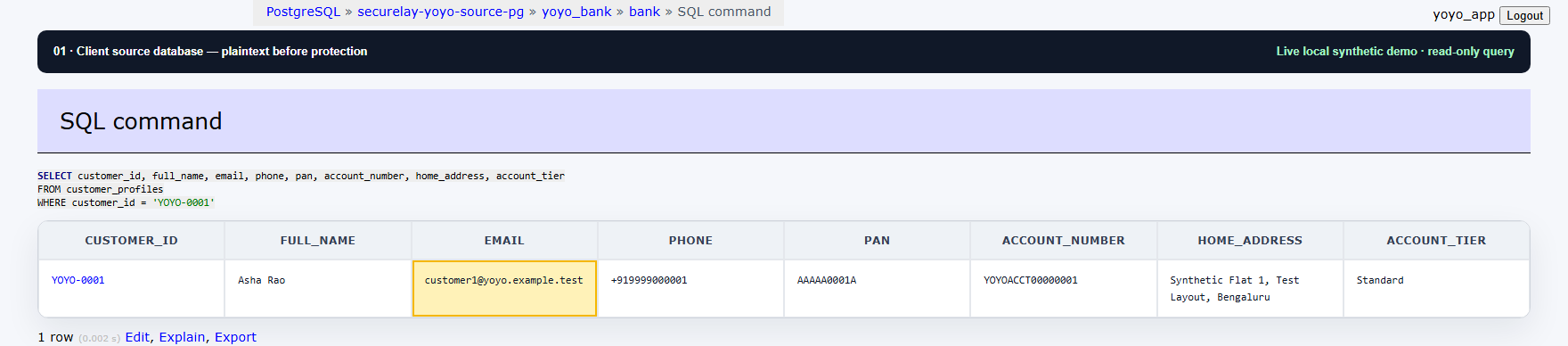
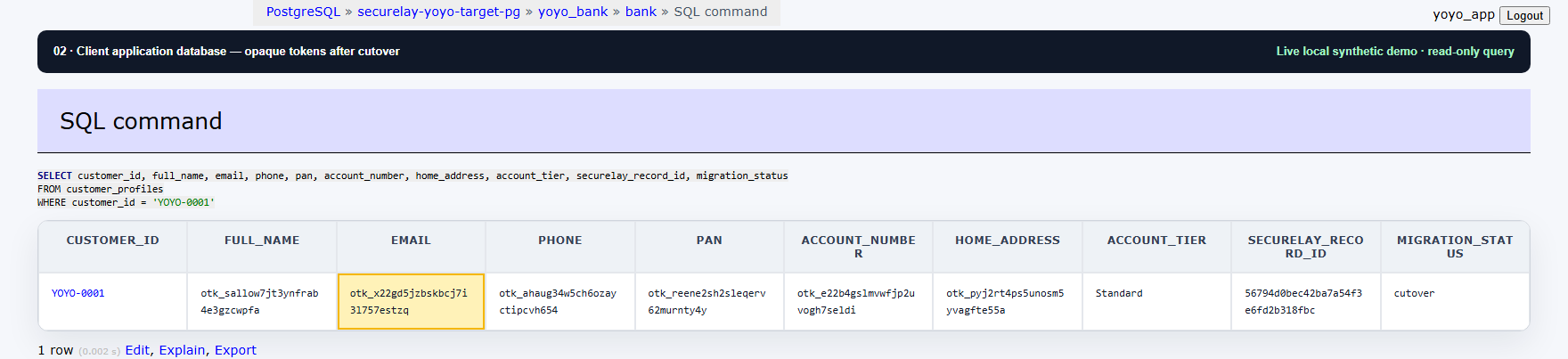
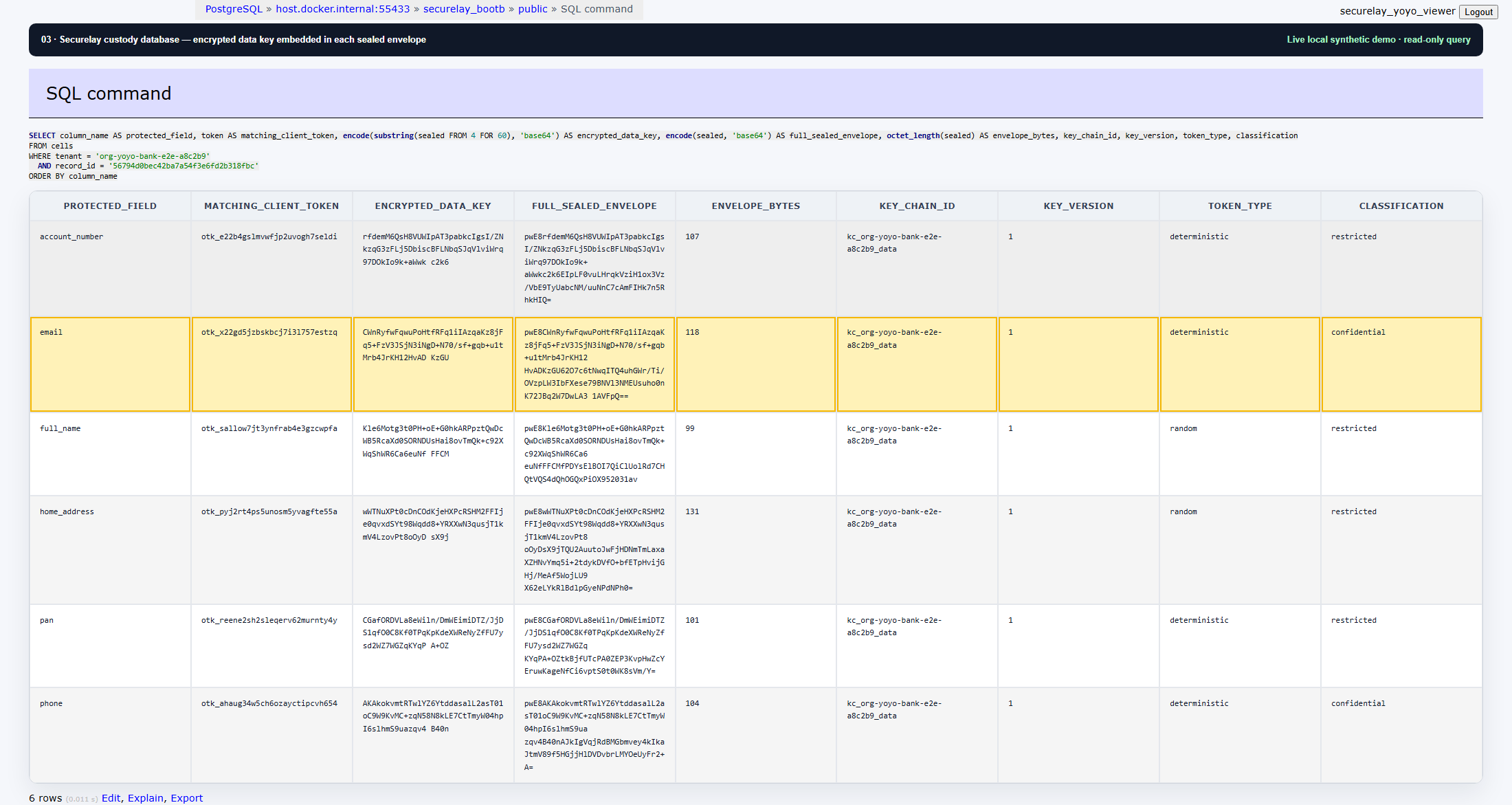
Three real views from one synthetic customer path: source plaintext, application tokens, and sealed Securelay custody.
Plaintext before protection
 Open full image
 Personal details appear in the original record.
Opaque tokens after cutover
 Open full image
 Selected fields become tokens. The application keeps its customer record.
Sealed ciphertext, isolated by field
 Open full image
 The protected values are held separately, encrypted by field.
What these screenshots prove. Protection applies to the fields and routes you connect. Tokenization reduces exposure; it does not make every copy or remaining field anonymous.
Run the boundary where the data lives.
Deploy Securelay into the customer account with the customer network, workload identity, database, and KMS boundary.
 Customer AWS account


